
A PETS OWNER’S GUIDE TO PET INSURANCE
This guide generally explains how pet insurance works, what to evaluate when comparing policies, and how to decide whether coverage fits your financial needs.
Pet Insurance is Not Like Human Medical Insurance – Use Any Provider!
One of the most common questions we are asked by pet owners is, “What Pet Insurance(s) do you accept?” Many people are used to this being an important question with human medical insurance, but it is important to understand that pet insurance is different, and that difference means you can use any provider!
- With Human Medical Insurance, fees and services are often pre-negotiated between the insurance company and the care provider (doctor, hospital) – which is why human medical insurance may only be accepted with providers who have pre-negotiated with the insurance company.
- With Pet Insurance, there is no relationship between the insurance company and provider – the arrangement is strictly between the insurance company and the client (pet owner). Pet Insurance uses a reimbursement model, in which the pet owner pays for services to the care provider and submits receipts to their insurance company for reimbursement. As a result, you can use your Pet Insurance anywhere!
Pet Insurance is Not a Cost-Saving Product – It is a Risk-Mitigation Product
In general, Pet Insurance is like any other insurance, in that it is a financial product sold to a group to pool their collective risk(s). Enrolled members pay into the “pot” in the form of monthly premiums, and some of the money in the “pot” comes out each year to pay qualifying claims. The insurance company carefully calculates the risks of paying out claims to ensure that more money comes into the “pot” from premiums than goes out in claims. The insurance company then keeps some of the difference to cover overhead costs, profit and a return for the financial company underwriting the insurance program.
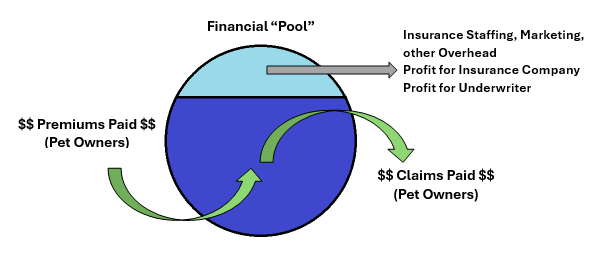
With this core understanding when looking into pet insurance for your pet(s), you can have the following reasonable expectations:
- On average, across the insured group, members will be paying more towards medical care. This is because of the funds drawn from the “pot” each year to cover overhead costs, etc. When you do have a qualifying claim, you will be glad to be insured, but – unless you are very unlucky – there will be more months or years in which you don’t have qualifying medical expenses and pay more into the “pot” than you take out.
- When comparing plans, a lower premium is not necessarily “better.” Lower monthly premiums are often going to be accompanied by more exceptions and exclusions to reduce the claims going out – less going in, less going out. It is advisable to inquire about the % of premiums that are paid out as claims when comparing companies to find out how much the company is pulling from the financial pool each year.
- Something happens to everyone, eventually. Some pets may get lucky and live mostly healthy lives. Some may be unlucky and have a major medical or emergency event happen to them…possibly more than once! Nobody has the crystal ball to know what your pets’ future holds. The main value of Pet Insurance is hedging your financial risk of unexpected medical expense(s) within the risk pool of enrolled members.
Pet Insurance can be a helpful tool in budgeting for your pets’ medical care. Although on average it may increase your total cost, it can help make those costs more predictable.
Plan to Pay First and Receive Reimbursement Later
A key aspect of Pet Insurance to be prepared for with its reimbursement model is that you will need to pay your bill first, then submit for reimbursement. Insurance claims can take days to weeks to be processed, and a major unexpected medical or emergency event can add up to thousands of dollars quickly. To be prepared and take full advantage of your Pet Insurance policy when you have a qualifying medical expense, it can be helpful to have:
- A high balance checking, savings or other liquid financial account
- A high balance credit card reserved to cover the payment until you are reimbursed
- A medical credit card (e.g. Care Credit) or other financing option to cover the payment until you are reimbursed
Don’t Make Assumptions – Read Your Policy!
One of the most common and frustrating mistakes to be made when choosing and using Pet Insurance is a failure to read the Policy. Do not assume anything about an Insurance Policy! Make sure you are aware of what you are paying for, what are qualifying claims expenses, what exceptions there may be and any opportunities the insurance company may have to modify your pet’s premium or drop their coverage. Ask lots of questions of the insurance agent(s)!
Your Veterinarian’s Role With Pet Insurance
As noted previously, Pet Insurance is independent of your veterinarian. Your veterinarian should continue to recommend and provide care for your pet(s) the same as if they were not insured. Your Pet Insurance company may request record(s) from your veterinarian to facilitate claims review.
If your Pet Insurance company is trying to deny a qualifying claim, you can ask your veterinarian for help! Be sure to provide your veterinarian with the documentation and contact information from your insurance company that they will need to help dispute a denied claim.
Is Pet Insurance Right For Me?
This is also one of the most common questions we are asked about Pet Insurance. The answer to this question is very personal, which will make it impossible for your veterinarian to answer this question for you. Here are some considerations that may help you answer this question yourself:
- What is your financial risk tolerance when it comes to your pet’s medical care? As you budget for your pet’s future care, could you handle a sudden expense in the hundreds or thousands? Particularly if and when specialty or emergency care is needed, costs can add up quickly. If you are fairly risk-tolerant, insurance may not have as much value for you; if you are risk-averse, it may have more value to have the peace of mind that an unexpected expense would be mitigated. Understanding how much your budget will tolerate a sure expense relative to a possible additional expense can also influence choices regarding the trade-offs of monthly premiums relative to deductibles – often, lower monthly premiums will be associated with higher deductibles and vice versa.
- Are there any other factor(s) that may reduce your pursuit of medical care for your pet(s), and how much do those impact your decision-making? As noted above, Pet Insurance is a financial product that can help reduce the risk of an unexpected larger medical expense. There are many factor(s) that can influence a pet owner’s decision whether or not to pursue recommended diagnostic or therapeutic care for their pet(s). If other factor(s) would prevent you from pursuing certain medical care regardless of finances, Pet Insurance covering those situation(s) may have less value. There are diverse Pet Insurance products out there, so you may still find one catered to what you would want your pet(s) covered for.